brucebawer.com
The website of Bruce Bawer, writer and translator.

Click here for blog

black01_next.gif My latest book

Just out in paperback...


While Europe Slept: How Radical Islam Is Destroying the West from Within   

(CLICK ON TITLE TO PURCHASE)

(CLICK HERE TO READ REVIEWS)

(CLICK HERE TO READ A SUMMARY OR EXCERPT AT RANDOMHOUSE.COM)

“A book of the utmost importance, full of deep concern for Europe and almost unbelievable revelations for most Americans.”  - Booklist

Europeans would do well to heed Mr. Bawer's advice and open their eyes.”
- Abraham H. Foxman, National Director, Anti-Defamation League


I have read no argument or book more viscerally convincing on this subject.”

- Roger L. Simon, rogerlsimon.com

“A clarion call for the West to understand the radical threat to our freedoms from politicized fundamentalist Islam.” - Andrew Sullivan

“Must-read book….timely and incisive...Bawer describes a landscape of dysfunction.” 
- Carlin Romano,
Philadelphia Inquirer

Indispensable.” - J. Peder Zane, Raleigh News and Observer

Bawer makes his case moderately but eloquently and powerfully. Will Europeans heed his warning?”  - Daniel Pipes

A
stunner of a book.”  -Andre Zantonavitch, The American Thinker

Some books are merely important.  This one is necessary.” - Jonathan Rauch

The sweeping and dramatic shift going on in Europe is chronicled to stunning effect....as enlightening as it is disturbing....if you want to understand the car burnings, the killings over cartoons and films, and other outrages sure to come, you won't do any better than While Europe Slept.”
- Scott C. Yates,
Rocky Mountain News

In a sane world, it would be required reading in all European and American universities.”  - Robert Spencer

“Riveting, disturbing, fascinating, chilling, and shocking....required reading for anyone who wants to understand how militant Islam has insinuated itself into the heart of the West.” - Steven Emerson

A sensitive and sober portrait of an increasingly insensitive and reckless continent.”  - Victor Davis Hanson

Blødende og intelligent indignation, fuld af skammelige og skarpe observationer.”
- Klaus Wivel, Weekendavisen (Denmark)

Deeply thoughtful, persuasive and beautifully written."
- Douglas Murray,
Social Affairs Unit Web Review

A National Book Critics Circle Award finalist.


black01_next.gifHardcover edition

The hardcover edition is in its 
9th printing, with 50,000 copies in print.


black01_next.gifSpanish edition

Mientras Europa duerme

Publicado por Gota a Gota
Traducción de Isabel González-Gallarza


(SOBRE LA  EDICIÓN ESPAÑOLA)

"Un libro valiente, complejo y claro a la vez, y además ameno como pocos. Se lee de un tirón, sin exageración de ninguna clase. No dejen de precipitarse a comprarlo, ahora mismo, en la librería más próxima. De lectura obligatoria."
- José María Marco, Libertad Digital


black01_next.gifDutch edition

Terwijl Europa Sliep

Uitgegeven door Meulenhoff
Vertaald door Thijs Bartels


(OVER DE NEDERLANDSE EDITIE)

...uitstekend geschreven...een boek dat iedereen in Europa zou moeten lezen.

- De Leestafel


black01_next.gifMy earlier books

Stealing Jesus: How Fundamentalism Betrays Christianity
1997 (paperback 1998)

(CLICK ON TITLE TO PURCHASE)

(CLICK HERE TO READ A SUMMARY AT RANDOMHOUSE.COM)


"Bawer's graceful prose and lucid insights make this a must-read book for anyone concerned with the relationship of Christianity to contemporary American culture." 
 -
Publishers Weekly.

"Groundbreaking."
- Library Journal.

"Bawer lauds liberal Christianity as the essence of the Gospel, the kind of religion that Jesus would both recognize and practice because he preached it.  This is a passionate, articulate, timely, and utterly useful book."
 - Peter J. Gomes, Wilson Quarterly

"An adventure in American religious thought, exciting and intelligent." -
Booklist.  

"Stealing Jesus may prove of value simply for its clear exposition of what today's American ''fundamentalists'' believe and want to do. Bawer's readers will no longer be able to greet that term with a condescending smile. The Church of Law, as he convincingly demonstrates, does not debate, and it takes no prisoners."
-
Walter Kendrick, New York Times Book Review.   Link to Kendrick's review.


A Place at the Table: The Gay Individual in American Society
1993  (paperback 1994)

(CLICK ON TITLE TO PURCHASE)


"Courageous and thought- provoking."  

- Margaret O'Brien Steinfels,
New York Times Book Review
.  

"If there is one book about homosexuality and gay rights that everyone should read, it is probably this one."  
- John Fink,
Chicago Tribune.

"Powerful and important...the blockbuster of the season." - Steve Petrow, The Advocate.

"Challenging and compulsively readable...tightly reasoned and responsible."
- Bob Summer, Lambda Book Report.

"Courageous."  - Jonathan Yardley, Washington Post Book World.

"A quiet, dispassionate voice trying to be heard above the din."
- John Heidenry, New York Daily News.


"Brings cool reasoning to the
heated battlefield of gay rights....Rigorous, eloquent and full of good sense...a timely arrival in a debate that needs more reason and less rancor."
- Steve Murray,
Atlanta Journal-Constitution.

"One of the most sensible assessments of the gay rights movement that's ever been written, as well as one of the most eloquent arguments for acceptance of gays that's ever been made."

- Frank Bruni, Detroit Free Press.

"Of all the sinkholes in American politics, the debate over homosexuality is the rankest....With the bracingly rational passion of a writer who can think and feel at the same time, [Bawer] charts a path out of the swamp."
- Jonathan Rauch, Wall Street Journal.

"Eloquent...This could be the crossover book many have been waiting for -- plain and sane talk about a complex issue...[that] should be the starting point for all future debate."  - Kirkus Reviews.


Prophets and Professors  1995
 

(CLICK ON TITLE TO PURCHASE)

"A rare pleasure: a richly detailed, erudite, and non-academic (huzza!) critique...that is positively thrilling in its unabashed love of poetry and commitment to the project of restoring some semblance of order to its chaos....."  -Booknews

"Bawer is one of the appallingly few American literary journalists whose work repays the reading; he is an intelligent, independent, tough- minded critic and a clear-eyed observer of literary affairs."
 - Jonathan Yardley,
Washington Post.
 

"Immensely readable...Provocative and entertaining, filled with intelligence and fight."
- Andrea Barnet, New York Times Book Review
    Link to Barnet's review


Includes essays on Emily Dickinson, H.D., W.C. Williams, Wallace Stevens, Conrad Aiken, I.A. Richards, Louise Bogan, Delmore Schwartz, Randall Jarrell, John Berryman, Dylan Thomas, the Beats, Allen Ginsberg (discussed here), Sylvia Plath, Richard Wilbur, Donald Justice, Helen Vendler, Dave Smith, Vikram Seth, formal poetry, literary interviews, PBS's Voices and Visions, plus short reviews.


Coast to Coast: Poems 
1993
 

(CLICK ON TITLE TO PURCHASE)

Named the year's best first book of poetry by the Dictionary of Literary Biography Yearbook.  Excerpts here.


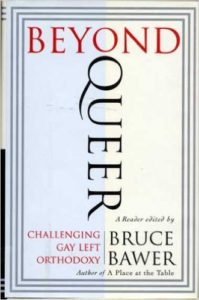
Beyond Queer:
Challenging Gay Left Orthodoxy
(ed.)
1996
(CLICK ON TITLE TO PURCHASE)


"Marks the end of radical dominance in gay politics and culture, the beginning of a pragmatic and democratic approach to gay issues."  - Ray Olson,
Booklist.  

Includes essays by Bawer, John W. Berresford, David Boaz, Stephen H. Chapman, Mel Dahl, David Link, Carolyn Lochhead, Daniel Mendelsohn, Stephen H.Miller, Jonathan Rauch, Andrew Sullivan, Paul Varnell,  Norah Vincent, John Weir.

(Essays from Beyond Queer, plus other work by the same writers, can be found at the
Independent Gay Forum website.)


Innocence  1988


(CLICK ON TITLE TO
PURCHASE)


black01_next.gifNo longer available:

House and Home
(with Steve Gunderson
and Rob Morris)
1996


The Aspect of Eternity 1993
"...a literary essayist of the highest order."
- Kirkus Reviews.


The Screenplay's the Thing
1992


Diminishing Fictions
1988  


The Contemporary Stylist
1987


The Middle Generation: The Lives and Poetry of Delmore Schwartz, Randall Jarrell, John Berryman, and Robert Lowell 1987   

"A critic of the first order,
one of the best we have today."

- Robert Phillips,
Commonweal.
_________________________________
black01_next.gifBooks I've translated
(CLICK ON TITLES TO PURCHASE)

Capital of Culture Stavanger 2008  2007 
By various authors


Themes  2007
By Odd Nerdrum, with an introduction by Bjørn Li, translated by B.B.


Into the Ice  2006 
Ed. by Einar-Arne Drivenes & Harald Dag Jølle; translated by B.B., Deborah Dawkin, Joan S. Rongen & Erik Skuggevik


Lars Elling Paintings  2006


Eyewitness: The Christian Bjelland Collection    2006
By Hans-Jakob Brun


Visions: Eye on Dance  
2005
By Kjersti Alveberg


Cover of Human Visas fort: HRS

Human Visas: A Report from the Front Lines of Europe's Integration Crisis  2003
By Hege Storhaug & HRS

_________________________________

black01_next.gif
Blog

Archive, January-August 7, 2007
Archive, 2006

Demo in Oslo, Dec. 4, 2004 
Archive, 2002

_________________________________

black01_next.gif
About me
black01_next.gif Om meg

_________________________________

black01_next.gifContact info

Media inquiries
Lecture inquiries


Entire contents of website, including all texts, music and lyrics, sound recordings, and original photographs (but not including photographs of book covers, newspaper front pages, and the like, or photographs accompanied by links to other sites), copyright © 2008 and earlier dates by Bruce Bawer. 

Please do not copy anything from this site without permission. 

black01_next.gif Some of my recent writings...
Most recent first. 
Capote's small, exquisite gem 
WALL STREET JOURNAL, 19 April 2008
"If Norman Mailer was, or at least sought to be, the postwar generation's answer to Hemingway, Truman Capote was its F. Scott Fitzgerald -- elegiac, lyrical, a pitch-perfect literary stylist who memorably dismissed his slapdash Beat Generation contemporaries in five words: 'that's not writing, that's typing.'"
 An anatomy of surrender  CITY JOURNAL, Spring 2008
"Ayatollah Khomeini's 1989 fatwa against Satanic Verses author Salman Rushdie introduced a new kind of jihad."
  Marchen mod mørket SAPPHO, 15 April 2008
"Ved at udgive den gør hun alle os en betydelig tjeneste, vi, der marcherer mod mørket uden at vide, hvad vi foretager os."
First they came for the gays  PAJAMAS MEDIA, 29 January 2008
"Sharia law may still be an alien concept to some Westerners, but it’s staring gay Europeans right in the face – and pointing toward a chilling future for all free people."
Farshad Kholghis selvbiografi  SAPPHO, 15 January 2008
"En lidenskapelig, kunnskapsrik og overbevisende advarsel om den fremtiden som venter hele Vesten om vi fortsetter å lukke øynene for den dystre virkeligheten."
Why I haven't caught Obama fever  PAJAMAS MEDIA, 4 December 2007
"Forget the content of our character; this is a work preoccupied with skin color."
De homofiles mærkelige kammerat  SAPPHO, November 2007
"Damen som nekter å håndhilse på menn, som har uttalt seg for jihadistene i Irak, som var frontfigur for foreningene som politianmeldte Jyllands-Posten i karikatursaken og som står i spissen av forsøket på å gjøre hijab til en alminnelig del av den danske hverdagen, har høstet ros hos noen av Københavns mest profilerte homofile."
On reactions to Hege Storhaug's latest book  PAJAMAS MEDIA, 2 November 2007
"As Europe’s Islamization proceeds apace, the gap widens between ordinary folks’ growing recognition of the outrages that are going on all around them and the movers and shakers’ cynical insistence on pretending that everything’s just hunky-dory."
The way of all flesh  HUDSON REVIEW, Autumn 2007
"
The cumulative effect [of Seven Up] is, indeed, poetic. Growing out of a program designed by socialists to promote a collectivist worldview, the series might almost have been created by libertarians to underscore the singularity and integrity of the human person."
The peace racket  CITY JOURNAL, Summer 2007
"Peace studies students discover that the lesson of World War II is the evil of war itself, and the need to prevent it by all possible means--which, of course, is exactly what Chamberlain thought he was doing in Munich."  A shorter version in the L.A. Times.
Cinco años sin Pim Fortuyn  LA ILUSTRACIÓN LIBERAL, Summer 2007; LIBERTAD DIGITAL, 20 July 2007
"El breve pero brillante momento de Fortuyn parece hoy tan lejano."
2001 THE STRANGER, 21 June 2007
"...don't let anybody tell you that being concerned about other people's hatred of you makes you a bigot."  Reply to letter here.
En politikers død  RIGHTS.NO, 7 May 2007
"Fortuyns korte lysende øyeblikk synes å være lenge siden."
Europe's champion of liberty NEW YORK SUN, 4 May 2007
"Fortuyn's brief shining moment seems very long ago."
Dos líderes europeos: Fogh Rasmussen y Zapatero LIBERTADDIGITAL, May 1, 2007
"Su defensa inquebrantable de la democracia y la libertad de expresión han convertido a Anders Fogh Rasmussen en el europeo de estos días más próximo a Winston Churchill. Zapatero, en cambio, nos recuerda a Neville Chamberlain."
NOT AVAILABLE ONLINE.  Didion's dreamwork  HUDSON REVIEW, Spring 2007
"...she views her emotional fragility not as a weakness but as a mark of higher sensitivity – a sign of a sensibility more delicately attuned than other people’s."
Venstreintellektuelle er en trussel mot frihet og sikkerhet  RIGHTS.NO, March 19, 2007
"Det er naturligvis mindre farlig å gjøre seg til venns med de som steiner og pisker enn å stille opp for de som blir steinet og pisket."
On Dinesh D'Souza's The Enemy at Home  THE STRANGER, February 5, 2007
"
Charging that 'the cultural left in this country is responsible for causing 9/11,' he wants good Christians to recognize that Islamic values resemble their own—and that the real enemy is those fags next door."
Staten er overalt!  MINERVA, January 2007                                       
"Jeg flyttet til Norge 1. april 1999.  Cirka 2. april begynte nordmenn å  fortelle meg hvor vidunderlig deres soialdemokrati var."
Hege Storhaug: fighting for human rights in Norway  THE NORSEMAN, January 2007
             "Storhaug has seen many labels attached to her name: Islamophobe, neoconservative, secular fundamentalist, extremist, racist, xenophobe.  Many of those who call her these things are people who routinely spout lofty multicultural rhetoric but who have not done a fraction of the kind of hands-on work Storhaug has done to help individuals in the Muslim community."
In the shadow of the Gulag: Tony Judt's Europe  THE HUDSON REVIEW, Winter 2007
"Judt expresses the hope that the European public will develop a 'patriotism for Europe'; but given how the EU works...the 'patriotism' he longs for would have to be founded...on a deference not unlike that of a serf toward his feudal lord."
Anglicans in America 
GUARDIAN UNLIMITED, December 19, 2006
"They thunder that their denomination has been taken over by gays and their supporters; the fact is that third-world Anglicanism has largely fallen under the sway of reactionary demagogues who have left Anglican traditions and values far behind."
While Sweden slept
NEW YORK SUN, December 8, 2006
"Though two-thirds of Swedes question whether Islam is compatible with Western society, this issue is simply not open for public discussion."
Blir degget med av eliten AFTENPOSTEN, December 6, 2006 
"Hva skal man mene når myndighetene behandler islamister som forakter demokratiet med respekt, mens Språkrådet - et statlig organ - nekter lojale, lovlydige og hardtarbeidende innvandrere retten til å kalle seg norske?"
Kuet av Janteloven 
RIGHTS.NO, November 29, 2006
"Islam betyr tross alt underkastelse….Og Janteloven er ganske enkelt et sett av direktiver som rett og slett befaler underkastelse."

Sending a grim message  NEW YORK SUN, November 27, 2006
"This is, in short, a man who opposes freedom of speech and women's equality — a man who would have cheered the execution of Salman Rushdie. The decision to invite him to perform at the Nobel Peace Prize Concert...sends a grim message about the values the Norwegian Nobel Committee exalts above all others."  In Dutch in De Volkskrant, December 5, 2006.

Is Europe waking up? RIGHTS.NO, November 11, 2006
 
"Hvis man tross alt kan tvinge et samfunn til å tie stille om visse ting, så er samfunnet halvveis erobret."
On Ian Buruma's Murder in Amsterdam  BOSTON GLOBE, October 8, 2006
"...frank criticism of Islam is as vital now as frank criticism of Christianity was to the Enlightenment."
On rising antigay violence in Europe RIGHTS.NO, September 21, 2006

"Det ubehagelige, men ubestridelige faktum, er at Europas islamisering er i ferd med å gjøre kontinentets storbyer mye farligere for homofile – punktum." 
9/11, five years later: a view from Europe  DE VOLKSKRANT, September 2, 2006 
"...
if we don’t cherish our liberties with the fervor that the jihadists treasure their faith, we’ll lose. "  Dutch translation here.


black01_next.gif Older pieces, by category

ISLAM AND THE WEST
Most recent first.
On the disgraceful treatment of Ayaan Hirsi Ali CHRISTIAN SCIENCE MONITOR, May 19, 2006
"That one of the noblest and bravest among Dutch public servants has faced the prospect of losing her citizenship is a measure of the degree to which some Dutch leaders prefer attacking the messenger to dealing with the acute social problems facing their country."
On the crisis in Europe HUDSON REVIEW, Winter 2006
A review of several books about Islam, Europe, and Islam in Europe. 
On radical Muslims in the U.S.
THE  NEW YORK DAILY NEWS, Mar. 16, 2006
"Yes, there are moderate Muslims in the West. But we shouldn't assume that they predominate, or will prevail without vigorous support."
On the cartoon controversy THE STRANGER  Feb. 2-8, 2006
"...millions of Europeans have already internalized Islamic taboos and accepted the need to curb liberties in order to 'keep the peace.'"
On Paul Berman's Power and the Idealists  THE STRANGER  Jan. 5-11, 2006
"Berman's goal is clear: At a time when many leftists' animosity toward George W. Bush has blinded them to the iniquities of al Qaeda, the Taliban, Saddam, et al., not to mention the best interests of people who've suffered under tyranny, he wants to hold up Fischer, Cohn-Bendit, and Kouchner as models of reflective and principled interventionist leftism."
On threats to free speech in Europe REASON ONLINE, November 30, 2005
"It's been a tough year for freedom of expression in Europe."
On the Paris rioting CHRISTIAN SCIENCE MONITOR, November 17, 2005
"The recent rioting in Paris suburbs and elsewhere in Europe should not have surprised anyone."
On Norway's alarming new speech restrictions   SAPPHO, October 15, 2005 
"Den 19. april 2005, under minimal offentlig bevågenhed og stort set uden offentlig diskussion, vedtog det norske Storting en lov, der med ét slag alvorligt begrænser befolkningens ytringsfrihed."  Norwegian original here.  In German here.
On Amsterdam after the murder of Theo van Gogh  NEW YORK TIMES, November 14, 2004
"The Netherlands is undergoing a sea change."

On Muslim integration in Europe CHRISTIAN SCIENCE MONITOR, June 30, 2003
"Western Europe is increasingly a house divided."
On fundamentalist Islam in Western Europe
PARTISAN REVIEW, Autumn 2002
"Tolerance for intolerance is not tolerance at all."
On cooperation among the Bush White House, the Christian right, and Islamic states   BRUCEBAWER.COM, June 24, 2002
"...in the war between fundamentalist intolerance and democratic pluralism, which side is the Bush administration really on?"
On Pim Fortuyn   BRUCEBAWER.COM, 13 May 2002
"Right-wing bigot?  Hardly.  On most issues, Fortuyn was far more liberal than anyone in the U.S. political mainstream."    


LITERARY COMMENT
In alphabetical order, by the name of author reviewed.
On Laura Argiri's The God in Flight  WASHINGTON POST BOOK WORLD, March 12, 1995
"Arguably the best novel ever written about gay male love is by a woman, Mary Renault. Admirers of that book, The Charioteer, may experience moments of déjà vu while reading Laura Argiri's ambitious first novel..."
On Louis Auchincloss's Collected Stories NEW YORK TIMES BOOK REVIEW, December 4, 1994
"Yes, Mr. Auchincloss's social-register characters and stately prose often bring Wharton and James to mind; for some of us, that is not an unpleasant experience"
On Louis Auchincloss's Fellow Passengers WASHINGTON POST BOOK WORLD, March 28, 1989
"Many contemporary novelists are drawn to the subject of millionaires and their money; Auchincloss' concern, however, is not with wealth per se but with the ways in which rich people's means of earning, preserving, spending and losing their fortunes illuminate the principles by which they live."
Introduction to Louis Auchincloss, 92nd Street Y, New York, November 1, 2004
"But why, we may ask, shouldn't a first-rate novelist be as dependable as a first-rate trust attorney?" 
On John Banville's Shroud NEW YORK TIMES BOOK REVIEW, March 16, 2003
"In his novels, truth is elusive, but it matters; the self may be a prison built on shifting ground, but it exists."
On John Banville's The Book of Evidence  WALL STREET JOURNAL, April 6, 1990
"Like Ford Madox Ford's The Good Soldier...The Book of Evidence is a cannily constructed novel about sex, betrayal and self-deception, a novel whose narrator's testimony is egregiously unreliable and laced with internal contradictions."
On Louis Begley's As Max Saw It NEW YORK TIMES BOOK REVIEW, April 24, 1994
"If Henry James had written an AIDS novel, one imagines that it would have looked very much like Louis Begley's As Max Saw It."
On Julia Blackburn's The Leper's Companions  NEW YORK TIMES BOOK REVIEW, April 18, 1999
"Among much else, one comes away from this book with a strong sense of how deeply grounded the spiritual is in the physical, and of the degree to which modern comforts and conveniences, by insulating us from nature, also distance us from God."
On Allan Bloom's Love & Friendship  INSIGHT, July 19, 1993
"Even a reader who strongly shares Bloom's alarm about the cheapening of sex may find it illogical to try to draw lessons about that process from a comparison of the inner life of the average American today with that of Anna Karenina or Mark Antony."
On Wayne Booth's The Company We Keep  THE AMERICAN SCHOLAR
"For a critic who addresses Big Questions, he says precious little that is fresh, perceptive, or startling; he seems to have aimed no higher than meticulousness and modesty."
On Frederick Busch's A Memory of War  NEW YORK TIMES BOOK REVIEW, February 16, 2003
"
For history's wounded, the making of stories is vital, curative; it provides something to build on and cling to."
On A.S. Byatt's The Matisse Stories  NEW YORK TIMES BOOK REVIEW, April 30, 1995
"Ms. Byatt deftly juggles an impatience with feminist ideology and a sharp insight into female sensibilities."
On Gerald Clarke's biography of Truman Capote WALL STREET JOURNAL
"To read Capote is to have the sense that someone has put together all the important pieces of this consummate artist's life, has given everything its due emphasis, and comprehended its ultimate meaning."
On Jim Crace's Quarantine  WASHINGTON POST BOOK WORLD, May 3, 1998
"Not only does Crace have the audacity to make Jesus a virtual secondary character; he serves up a Jesus whose personal imperfections... might induce many a conservative Christian to denounce this book as sacrilegious."
On Guy Davenport's life and career BOOKFORUM, April/May 2005
"It is hard to believe that Guy Davenport is dead, for few writers in our time have seemed so abundantly alive."
On Guy Davenport's The Hunter Gracchus  THE STRANGER
"Sentence by sentence, Guy Davenport’s essays remind us of what matters."
On Guy Davenport's A Table of Green Fields  WASHINGTON POST BOOK WORLD, December 19, 1993
"He’s hardly a household name, but for a small company of literate readers, Guy Davenport is almost a household god."
On Annie Dillard's The Writing Life  AMERICAN SCHOLAR
"...
she comes off not as a 'habitan' (to borrow Whitman's word) of God's creation but as a gushing tourist, too zealous and impatient in her quest for the Absolute, too quick to assert her discovery of it, and too passive in her ultimate relation to it."
On E.L. Doctorow's City of God  HUDSON REVIEW, Autumn 2000
"Gradually, one comes to recognize that most of Doctorow's distortions of the Episcopal Church are thoroughly deliberate."
On Fernanda Eberstadt's The Furies  NEW YORK TIMES BOOK REVIEW, September 14, 2003
"Eberstadt manifestly wants to come across in these pages as a fearless adversary of all things facile and ignorant, but those attributes, alas, pervade her meditations on love, sex and commitment."
On Per Olav Enquist's The Royal Physician's Visit  NEW YORK TIMES BOOK REVIEW, November 18, 2001
"Perhaps the most astonishing thing of all about this story that astonishes at every turn is that it took this long for someone to come along and tell it."
On F. Scott Fitzgerald's The Great Gatsby  WALL STREET JOURNAL, July 29, 2006
"The book is inhabited both by Fitzgerald's robust romanticism and his sense of moral censure -- each elegantly tempering the other."
On André Gide & the biography by Alan Sheridan   HUDSON REVIEW, Autumn 1999  
"As Sheridan convincingly argues, Gide never stopped being, in his own way, a Protestant missionary."
On William Goyen's The Lighthouse Keeper's Log THE NEW YORK TIMES BOOK REVIEW, July 17, 1994
"Goyen's paramount concern is with the ways in which people connect, commune and create, with the ways they hurt and heal one another and with the capacity of everyone to do good or evil. We are brothers; yet brotherhood can lead, as it did with Cain, to fratricide."
On Ismail Kadare's The Pyramid  NEW YORK TIMES BOOK REVIEW, April 28, 1996
"Mr. Kadare paints a hypnotic picture of a world drenched in death and crowded with stones."
On Nicholas Murray's biography of Franz Kafka   WILSON QUARTERLY, Autumn 2004
"Kafka's stark visions of estrangement, persecution, and punishment have been read as prophesies of Nazism and Stalinism, yet their origins often lie not in any encounter with authoritarian power but in domestic or romantic conflicts that wouldn't seem out of place on Beverly Hills 90210."
On Alfred Kazin's God and the American Writer and Janice Radway's A Feeling for Books  HUDSON REVIEW
"Kazin and Radway mark two ends of a spectrum. He clings heroically— quixotically?—to his canon; she rejects the very notions of taste and value on which that canon is based."
On John LeHeureux's The Miracle   NEW YORK TIMES BOOK REVIEW, October 27, 2002
"...as L'Heureux reminds us on nearly every page, people are imperfect, lacking in willpower, infirm in their beliefs, their lives cluttered and unfocused, their character traits largely impervious to change....Yet love can work through them to effect wonders."
On Norman Mailer's The Time of Our Time  HUDSON REVIEW, Winter 1999
"It's thanks to his celebrity, surely, that Mailer continues to be lavishly published and to be prominently reviewed.  Yet do people really read him anymore?"
On David Maine's Fallen  NEW YORK TIMES BOOK REVIEW, October 30, 2005
"...to read 'Fallen' is to be constantly aware that for the 6 out of 10 Americans who think the world was created precisely as described in Genesis, this is a historical novel."
On Martha McPhee's Gorgeous Lies   NEW YORK TIMES BOOK REVIEW, September 15, 2002
"If McPhee's first novel was a case of relatively orthodox storytelling, her second is a free-associative jumble of memory and emotion that makes the reader feel like a family therapist on marathon duty."

On Ib Michael's Prince  NEW YORK TIMES BOOK REVIEW, December 12, 1999
"The narrator's migration from flesh to flesh leaves a potent impression of life as a miraculous force, an imperishable essence that survives the individual's life span to bring youth, summer, delight -- princedom -- to generation after generation."
On R.K. Narayan's Talkative Man  WASHINGTON POST BOOK WORLD
"
Narayan brings to life people who are as familiar with casting calls as with the caste system, who quote from the Bhagavad-Gita and Shelley with equal facility, who marry at the age of 9 and earn BAs at 20, and who invoke the name of a Hindu god one minute and that of Errol Flynn the next."
On Deirdre Bair's biography of Anais Nin  NEW YORK TIMES BOOK REVIEW, March 5, 1995
"Nin took infidelity to new imaginative heights."
On the biography of Walker Percy by Jay Tolson  WASHINGTON POST BOOK WORLD, October 11, 1992
"Percy the Catholic was less a congregant than a lone prophet."
On David Plante's The Accident  WASHINGTON POST BOOK WORLD, May 19, 1991
"...
what differentiates this novel from the lackluster minimalistic fiction it resembles in some respects is its author's ability to convey, in a quiet and unobtrusive way, a sense of the mystery that lies beyond the mundane, and his insistence upon the abiding relevance of the Important Questions..."
On Richard Powers's Gain NEW YORK TIMES BOOK REVIEW, June 21, 1998
"...
to read Powers's story of the shaping of today's commercial culture is to feel as if one has never before seen that culture quite so clearly or acquired such a vivid understanding of the dynamic, generations-long process that brought it into being."
On Richard Powers's Operation Wandering Soul   WASHINGTON POST BOOK WORLD, June 13, 1993
"At its best, one might say, Powers's prose itself soars like the most magnificent of choirs, memorably capturing the moments of joy and anguish, barrenness and grace, that add up to life."
On Reynolds Price's The Promise of Rest WASHINGTON POST BOOK WORLD, July 16, 1995
"
There's nearly always been a distant formality in Price's fiction, as if he were erecting a battlement of words to protect some vulnerable private place; here that quality is less pronounced than usual."
On Marcel Proust's life & work   HUDSON REVIEW, Autumn 2001
"On every page, Proust reminds us how rich life is with things of beauty that we never recognize as such and with depths of meaning that we never bother to plumb, let alone articulate fully and precisely."
On James Purdy's Gertrude of Stony Island Avenue  NEW YORK TIMES BOOK REVIEW, August 30, 1998
"Love, death, family, emotional estrangement -- these are among Purdy's major themes, and few writers have written less sentimentally about any of them."
On David Sweetman's biography of Mary Renault  WALL STREET JOURNAL, June 25, 1993
"To the argument that 'women had never produced a Shakespeare or a Beethoven because they had been kept at the kitchen sink,' Renault responded sardonically: 'as if you could keep Shakespeare at a sink, if she was Shakespeare she wouldn't let you.'"
On Joan Shelley Rubin's The Making of Middlebrow Culture NEW YORK TIMES BOOK REVIEW, April 12, 1992
"For many a reader, finally, the chief problem with -- and ultimate irony of -- The Making of Middlebrow Culture may be that it is itself, for the most part, resolutely middlebrow."
On Salman Rushdie's The Moor's Last Sigh   INSIGHT,  February 12, 1996
"Magic realism at its best comes off as an act of reverence for the world, an expression of awe at its beauty, richness and mystery; at its worst the effect is that of an overambitious writer straining for effect but failing to imagine his way into the heartbreaking silences and vulnerabilities of a solitary human heart."
On Allan Stein & other novels by Matthew Stadler   HUDSON REVIEW, Spring 1999
"To be a truly serious literary artist is to accept and to plumb one's deepest and most distinctive obsessions, and Stadler, with each book, has engaged his obsessions more and more boldly and explicitly."
On Hjalmar Söderberg's The Serious Game  NEW YORK TIMES BOOK REVIEW, May 26, 2002
"For Soderberg, life isn't a matter of applying strict moral rules but of trying to meet unforeseeable challenges in a reasonably civilized fashion."
On Allen Tate and the Agrarians   HUDSON REVIEW, Spring 2002
"At a time...when America’s intellectual elite should have been lifting high the torch of democracy, Tate and company were serving up proposals for social change derived from the pre-Civil War slaveholding states and the French fascist movement."
On Linn Ullmann's Grace  NEW YORK TIMES BOOK REVIEW
"Since Ullmann is the daughter of Liv Ullmann and Ingmar Bergman, it's hardly surprising that this book is bleak and quintessentially Scandinavian, at once an austere portrait of mature couplehood that recalls 'Scenes From a Marriage' and a meditation on mortality, replete with echoes of 'Wild Strawberries' and 'The Seventh Seal.'"
On Alex Ullmann's Afghanistan  WALL STREET JOURNAL, October 15, 1991
"Dazzlingly written, impeccably shaped and strangely moving, this story of fathers, sons and the mystery of manhood marks a fresh and luminous debut."   Ullmann's obituary.
On Sigrid Undset's Jenny  NEW YORK TIMES BOOK REVIEW, June 3, 2001
"Paradoxically, Undset was at once her nation's most conspicuous violator of traditional sex roles and (in a series of notorious antifeminist jeremiads) their most vocal champion..."
On John Updike's More Matter: Essays and Criticism   HUDSON REVIEW, Spring 2000
"For Updike, seemliness is paramount.  And this, to my mind, is his distinctive failing as a writer: that he has exalted charm and mannerliness above all else..."
On John Updike's Odd Jobs 
WALL STREET JOURNAL, November 21, 1991
"The more one reads this book, the more one wonders: What passions rule this man? What makes him fume? Do any young novelists knock his socks off?"
On John Updike's Self-Consciousness  
WALL STREET JOURNAL
"Updike has made clear, in various places, his enthusiasm for Karl Barth's view of God as 'Wholly Other'; his coolly clinical approach to character gives one the impression that he considers his fellow man, too, to be Wholly Other."
On John Updike's Memories of the Ford Administration 
WASHINGTON POST BOOK WORLD, November 1, 1992
"...Alf s gripes about American decline and his sophomoric outlook...make him sound very much like an academic version of Updike's late, lamented alter ego, Harry Angstrom."
On Edmund White's The Farewell Symphony   WASHINGTON POST BOOK WORLD
"He began his literary career as the very model of the novelist as creator of austere, impersonal 'made objects'; he has ended up as one of America's premier practitioners of the novel as forthright personal confession."
On Jeffrey Meyers's biography of Edmund Wilson  WASHINGTON POST BOOK WORLD, June 2, 1995
"In these days when jargon-ridden works of academic theory pass for state-of-the-art literary criticism,  Edmund Wilson has become for many humanistic critics and literary journalists the quintessential symbol of The Way Things Used To Be."
On Jeanette Winterson's Gut Symmetries  NEW YORK TIMES BOOK REVIEW, May 11, 1997
"Rather than play on our sympathies, she takes us into her narrators' minds, showing how experience collides with belief and learning, how people labor to construct ideas by which to live."
On Tobias Wolff's In Pharaoh's Army NEW YORK TIMES BOOK REVIEW, November 27, 1994
"Mr. Wolff, who demonstrated in This Boy's Life his gift for capturing in terse declarative sentences a variety of discrete, elusive boyhood sensations, has done much the same thing in his new memoir for discrete, elusive wartime sensations."
On various poets, I   HUDSON REVIEW, Summer 2000
A review of America's Favorite Poems, Samuel Hazo, Wyatt Prunty, Jorie Graham, Lynn Emanuel, Baron Wormser, Donald Hall, Patricia Goedicke, and Frederick Turner.
On various poets, II   HUDSON REVIEW, Autumn 2001
A review of R.S. Gwynn, J. Allyn Rosser, Phillis Levin, Louise Glück, Ralph Black, Michael McFee, and Richard Tillinghast.  
On various poets, III   HUDSON REVIEW, Winter 2004
A review of Poets against the War, Robert Lowell, Joseph Harrison, Timothy Murphy, Gerry Cambridge, and Deborah Warren.
On various poets, IV   HUDSON REVIEW, Spring 2006
A review of Daniel Hoffman, Wendell Berry, Kay Ryan, Anne Stevenson, B. H. Fairchild, and Billy Collins. 
On several Nordic novels  
HUDSON REVIEW, Autumn 2003
A review of novels by Amalie Skram, Sigurd Hoel, Hans Kirk, Hallgrímur Helgason, Jens Christian Grøndahl, Erik Fosnes Hansen, Henning Mankell, Liza Marklund.


GAY LIVES, GAY RIGHTS
Most recent first.
Norway: Gay heaven?  
EUROPRIDE 2005
"As far as gay rights is concerned, Norway is a light unto the nations. The point is simply that here, as elsewhere, the struggle for full equality goes on
."
On gay men and houses  PRESERVATION, July-August 2005